A discussion on women-only spaces, safeguarding, biological sex, and the legal questions raised by the Tickle v Giggle appeal in Australia.
The recent decision in the Tickle v Giggle appeal has left many women shocked, frustrated, and deeply concerned.
The Full Federal Court upheld the finding that Roxanne Tickle, a transgender woman, was unlawfully discriminated against after being excluded from the Giggle for Girls app, and increased the damages awarded to $20,000. (ABC News)
This case has now become much bigger than one app, one founder, or one court ruling.
It raises a question that many women are asking, often quietly:
What happens to female-only spaces when biological sex is no longer allowed to matter?
Let me be clear.
I have nothing against trans people as people.
Every person deserves dignity, safety, and protection from cruelty, harassment, and violence. No one should be abused, mocked, threatened, or dehumanised because of how they identify.
But dignity for one group should not require women to surrender language, boundaries, safety, or spaces created specifically for females.
That is the issue.
Not hatred.
Not cruelty.
Not a lack of compassion.
The issue is safeguarding.
Women’s spaces exist for a reason.
They were not created randomly. They were not created to be fashionable or exclusionary. They were created because women and girls have historically needed places where their sex-based vulnerability is recognised.
Domestic violence shelters.
Rape crisis centres.
Women’s refuges.
Female changing rooms.
Female hospital wards.
Female-only support groups.
Spaces where traumatised women may already feel afraid, exposed, ashamed, violated, or unsafe.
For many survivors, especially women who have experienced male violence, the presence of a male-bodied person in those spaces is not a small detail. It can be deeply distressing. It can trigger fear. It can silence women all over again.
And this is where the conversation becomes uncomfortable.
Because women are often told to be kind, inclusive, patient, understanding, and accommodating.
But women are rarely asked what their boundaries are.
We are rarely asked what makes us feel safe.
We are rarely asked whether our trauma responses matter.
We are rarely asked whether female-only spaces should remain female-only.
Instead, women who raise these questions are too often accused of bigotry before their concerns are even heard.
That is not a fair conversation.
It is not hateful to say female spaces matter.
It is not hateful to say safeguarding matters.
It is not hateful to say biology matters.
It is not hateful to say women should be allowed to speak plainly about sex, safety, and boundaries.
There are two biological sexes: male and female.
A person may identify differently. A person may live socially as the opposite sex. A person may take hormones or undergo surgery. That is their life and their decision.
But identity does not erase biological reality.
And in certain spaces, especially spaces created for women recovering from male violence, biological reality is not irrelevant.
It is central.
This is not about assuming every trans-identifying person is dangerous. That would be unfair.
But safeguarding is not built around best-case scenarios.
Safeguarding exists because systems must account for risk.
The uncomfortable truth is that policies can be exploited by people with harmful intent. That is why boundaries exist in the first place. We do not create safeguarding rules because everyone is dangerous. We create them because vulnerable people need protection from the few who are.
Women should not have to wait for harm to occur before they are allowed to raise a concern.
They should not have to prove trauma before being believed.
They should not have to silence themselves to appear compassionate.
And they should not be forced to pretend that sex has no meaning in spaces designed to protect females.
This is why Sall Grover’s case matters to many women.
Whether people agree with her or not, the legal question being tested has national significance. The Federal Court decision provides guidance on gender identity discrimination under Australia’s Sex Discrimination Act, including how gender identity protections interact with sex-based spaces and “special measures.” (Australian Human Rights Commission)
But many women are now asking whether the law, as it currently stands, protects female-only spaces clearly enough.
That question deserves serious public discussion.
Not shouting.
Not name-calling.
Not instant cancellation.
Serious discussion.
Because if women cannot name the reality of their own sex, how can we advocate for women’s safety?
If women cannot speak about female-only spaces, how can we protect survivors?
If women cannot raise concerns about safeguarding, who benefits from that silence?
It is worth remembering this:
Silence has never protected women.
Clear boundaries have.
Women have fought for the right to vote, to work, to leave violent marriages, to report rape, to access refuges, to be taken seriously, and to have their pain recognised as real.
None of that progress happened because women stayed quiet.
It happened because women spoke.
Often at personal cost.
Often while being mocked.
Often while being told, they were unreasonable, hysterical, hateful, or difficult.
And now, once again, women are being asked to stay quiet about something that directly affects them.
I do not believe we should.
We can support the dignity of trans people while still defending the need for female-only spaces.
We can reject cruelty while still insisting on clear safeguarding.
We can respect individuals while still saying that sex-based boundaries matter.
This should not be an impossible position.
It should be common sense.
If Sall Grover seeks to take this matter further, including to the High Court, many women will be watching closely. Not because they hate trans people, but because they want clarity.
They want to know whether female-only spaces can legally remain female-only.
They want to know whether women are still allowed to speak about biology.
They want to know whether safeguarding women and girls still matters.
Because this is not just a legal issue.
It is a women’s issue.
It is a safety issue.
It is a truth issue.
And it is time we stopped being afraid to say so.
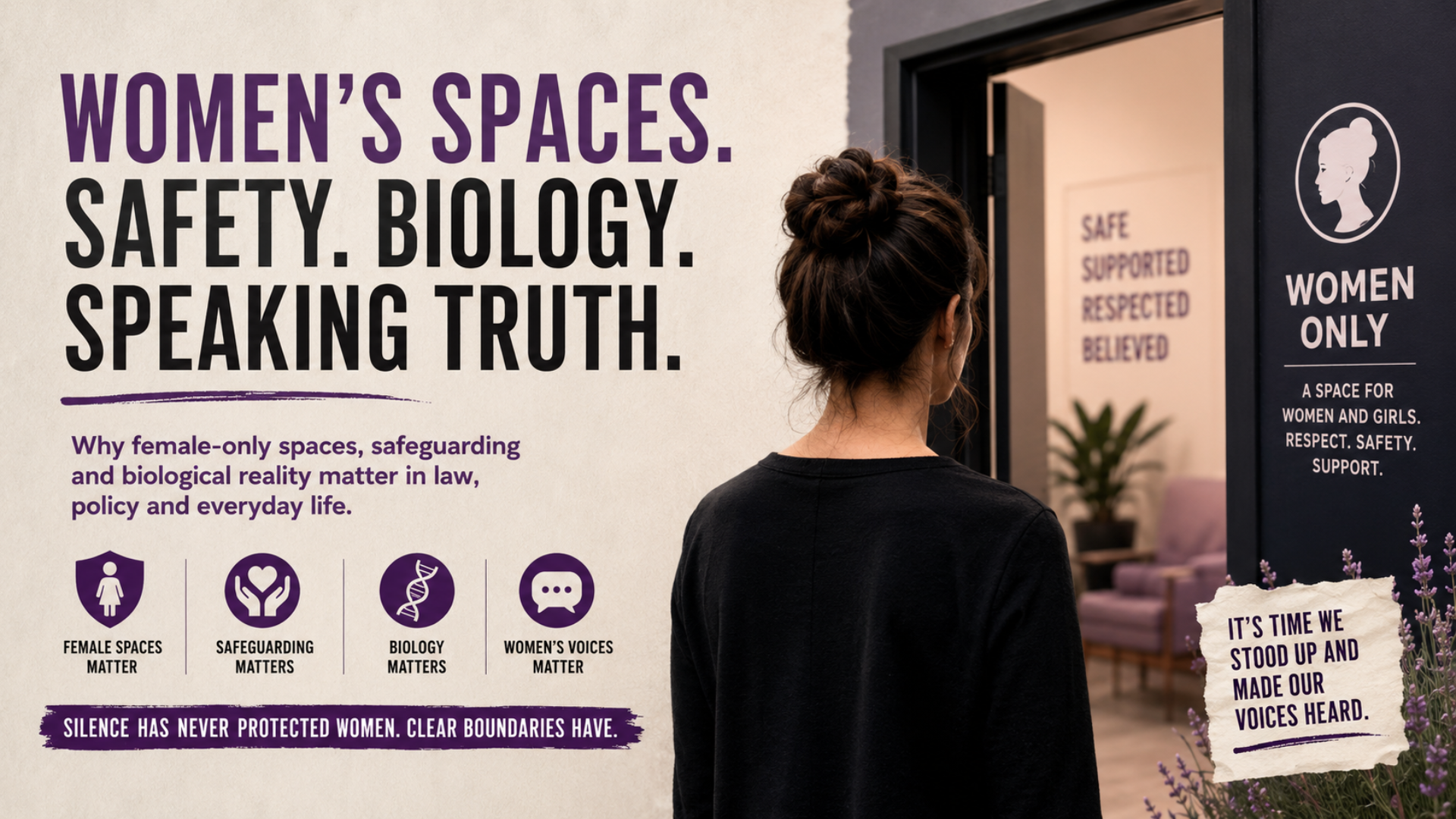
Female spaces matter.
Safeguarding matters.
Biology matters.
Women’s voices matter.
And women should never be shamed into silence for saying it.
Sources:
Federal Court of Australia, Giggle for Girls Pty Ltd v Roxanne Tickle (Appeal) online file. (Federal Court of Australia)
ABC News, “Court upholds discrimination ruling on appeal after transgender woman excluded from Giggle for Girls app,” 15 May 2026. (ABC News)
Australian Human Rights Commission, “Full Federal Court finds two acts of direct discrimination in Giggle v Tickle appeal,” 15 May 2026. (Australian Human Rights Commission)
Federal Register of Legislation, Sex Discrimination Act 1984. (Federal Register of Legislation)
Australian Human Rights Commission, “New protection against discrimination on the basis of sexual orientation, gender identity and intersex status.” (Australian Human Rights Commission)
Australian Institute of Health and Welfare, Family, domestic and sexual violence. (AIHW)
ANROWS, Using a trauma- and violence-informed framework in practice. (ANROWS)
#WomensRights, #FemaleSpaces, #SafeguardingMatters, #BiologyMatters, #WomenOnlySpaces, #TickleVGiggle, #SallGrover, #AustralianLaw, #SexDiscriminationAct, #WomensSafety, #SurvivorSafety, #DomesticViolenceAwareness #PublicPolicy, #FreeSpeech, #WomenSpeakingUp