
Lived experience storytelling is powerful.
It can heal.
It can connect.
It can create change.
But it also comes with risk.
Not just emotional risk for the person sharing the story, but ethical, social, and even professional risk when stories are shared without care.
Right now, storytelling is being encouraged everywhere.
“Share your story.”
“Be vulnerable.”
“Tell your truth.”
What is often missing is this:
No one is talking enough about how to do that safely.
As a Story Curator and Founder of The Impactful Voice Project™, I’ve seen both sides.
I’ve seen stories create deep connection and healing.
And I’ve seen stories shared too soon, too publicly, or without support — leaving people exposed, overwhelmed, or misunderstood.
This article is not about stopping people from sharing.
It is about doing it with care, clarity, and consent.
Why Lived Experience Storytelling Matters
Before we talk about the risks, it’s important to acknowledge the value.
When someone shares a lived experience story:
- It gives language to something others may not yet understand
- It helps people feel less alone
- It can challenge stigma and silence
- It creates connection beyond surface-level conversation
Stories are not just content.
They are moments of truth, often shaped by pain, growth, or significant life change.
When shared intentionally, they can be deeply impactful.
But that impact depends on how the story is told.
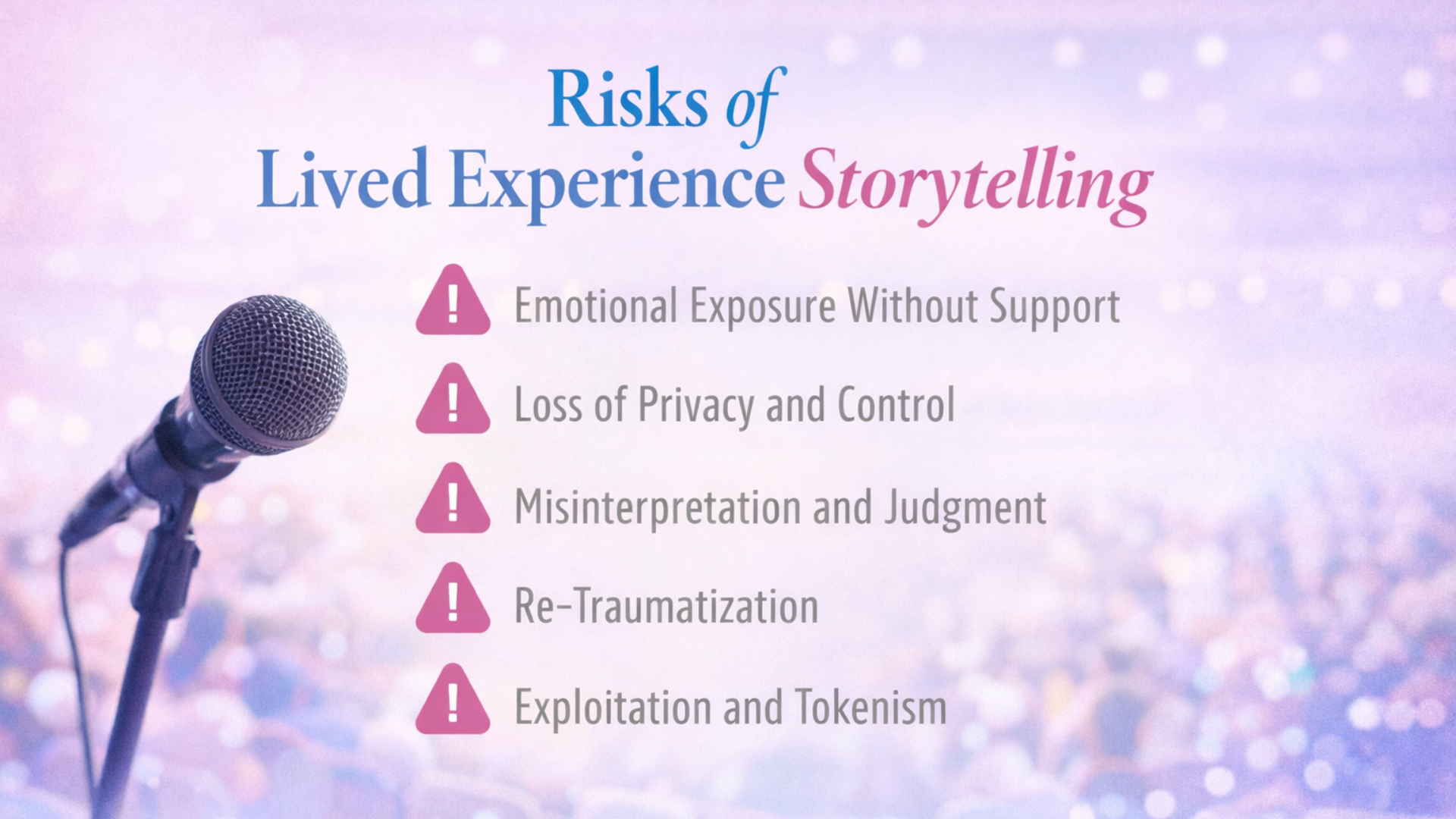
- Emotional Exposure Without Support
One of the biggest risks is sharing from a place that is still raw.
There is a difference between:
- Processing a story, and
- Presenting a story
If someone is still in the middle of the experience, or has not had time to reflect and stabilise, sharing publicly can reopen emotional wounds.
This can lead to:
- Emotional overwhelm after sharing
- Regret or second-guessing
- Increased anxiety or vulnerability
The reality is:
Just because you can share something, doesn’t mean you’re ready to.
- Loss of Privacy and Control
Once a story is shared publicly, it is no longer fully yours to control.
It can be:
- Re-shared without context
- Interpreted differently by different audiences
- Taken out of context
- Used in ways you did not intend
Even with the best intentions, the digital space does not guarantee protection.
This is especially important when stories involve:
- Family members
- Children
- Trauma
- Legal or sensitive situations
Without boundaries, storytelling can unintentionally expose more than intended.
- Misinterpretation and Judgment
Not everyone will understand your story.
Some people will:
- Project their own experiences onto it
- Misinterpret your intentions
- Disagree with your perspective
- Judge your choices
This can be confronting, especially when the story is deeply personal.
What was shared for connection can sometimes be met with criticism.
That doesn’t make the story wrong.
But it does highlight the need to be prepared for how it might be received.
- Re-Traumatization
Telling a story is not always healing.
In some cases, it can do the opposite.
Revisiting certain experiences — especially without support — can:
- Trigger emotional or physical responses
- Bring back unresolved trauma
- Create distress after the story is shared
This is particularly important in spaces where storytelling is encouraged without guidance.
Healing is not found in exposure alone.
It is found in safe, supported processing.
- Exploitation and Tokenism
There is also a broader risk within platforms and communities.
Stories can sometimes be:
- Used as “inspiration” without proper care
- Highlighted for emotional impact rather than meaning
- Shared for engagement rather than understanding
This can leave storytellers feeling:
- Used
- Misrepresented
- Reduced to a single moment in their life
Lived experience is not a marketing tool.
It is a human experience that deserves respect and context.
- Identity Lock-In
When a story becomes public, it can sometimes become the way others define you.
For example:
- “The survivor”
- “The person who went through…”
- “The one with that story”
While storytelling can be empowering, it can also unintentionally limit how others see you.
You are not just your hardest moment.
And your story should never become a label that replaces your full identity.
The Responsibility of Storytelling
With these risks comes responsibility.
Not just for the person sharing the story, but for:
- Platforms
- Podcast hosts
- Coaches
- Community leaders
- Media outlets
Anyone who invites or amplifies lived experience stories has a role to play.
That responsibility includes:
- Creating safe environments
- Offering clear guidelines
- Respecting consent and boundaries
- Avoiding pressure to share
Storytelling should never be extracted.
It should be offered, held, and respected.
The goal is not to silence stories.
It is to create a way for stories to be shared without harm.
Here are practical, grounded ways to do that.
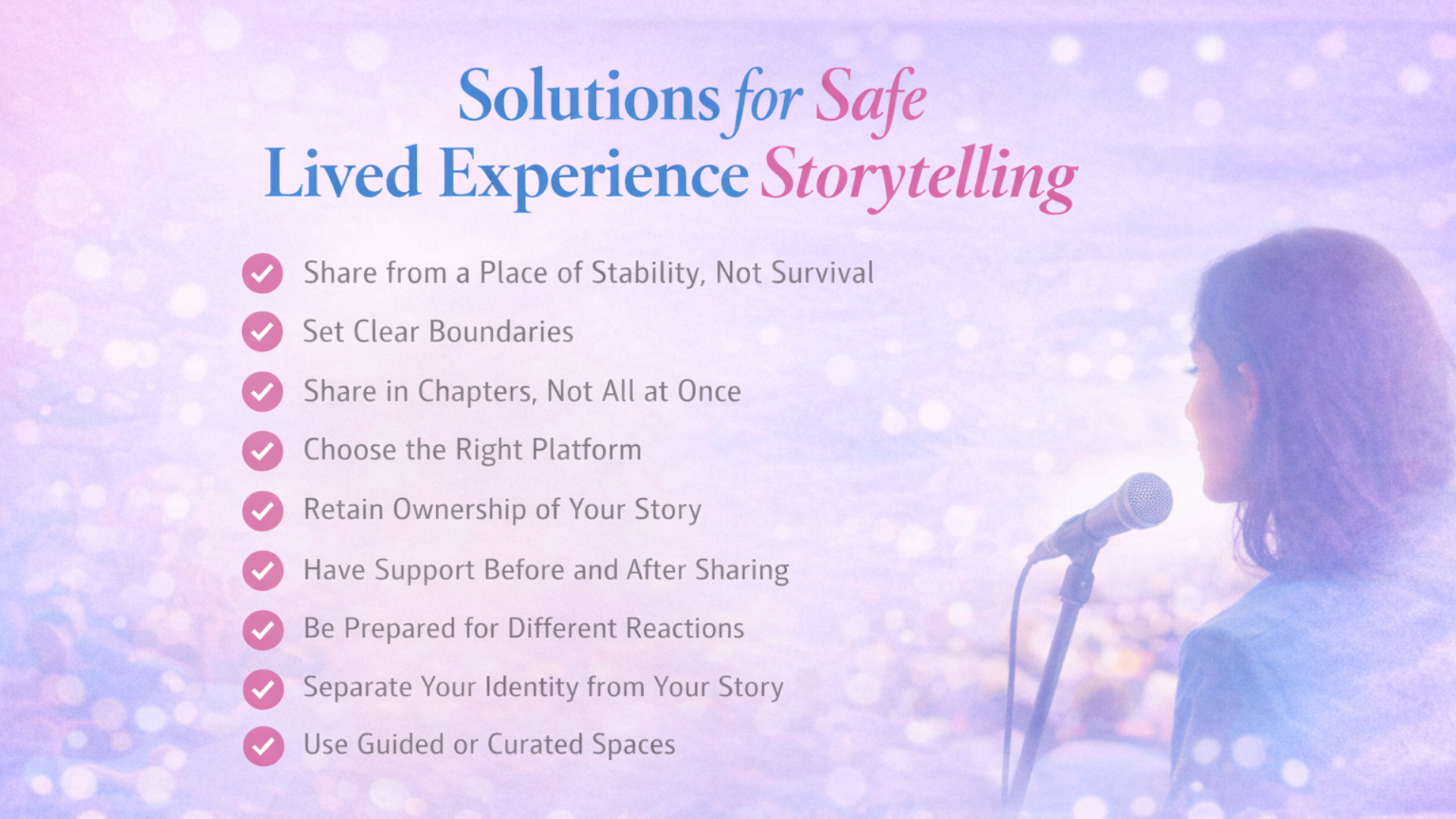
- Share from a Place of Stability, Not Survival
Before sharing, ask:
- Am I still in the middle of this experience?
- Have I had time to process what happened?
- Can I talk about this without becoming overwhelmed?
You don’t need to be “fully healed.”
But you do need enough distance to hold the story without it consuming you.
A helpful shift is this:
Move from “this is happening to me” to “this is something I have lived through.”
- Set Clear Boundaries
You do not have to share everything.
In fact, you shouldn’t.
Decide in advance:
- What stays private
- What you are comfortable sharing
- What details are unnecessary
Boundaries protect both you and the integrity of the story.
You are allowed to say:
- “I’m not ready to share that part.”
- “That detail is private.”
And you do not need to explain why.
- Share in Chapters, Not All at Once
Your story is not one moment.
It is a series of experiences.
Instead of sharing everything at once, consider:
- Sharing one part of the journey
- Focusing on a specific moment
- Building the story over time
This approach:
- Reduces overwhelm
- Allows reflection
- Keeps control in your hands
You are not required to tell your whole story in one sitting.
- Choose the Right Platform
Not every story belongs on every platform.
Ask yourself:
- Is this a safe space for this story?
- Who is the audience?
- How will this be shared or used?
Some stories are better suited for:
- Private conversations
- Guided interviews
- Curated storytelling platforms
- Therapeutic environments
Public platforms are not always the safest starting point.
- Retain Ownership of Your Story
Your story belongs to you.
Always.
If you are sharing through a platform, podcast, or publication:
- Understand how your story will be used
- Check if you retain ownership
- Review any permissions or agreements
You should never feel like you have “given away” your story.
You are sharing it.
Not surrendering it.
- Have Support Before and After Sharing
Storytelling does not end when the story is told.
Often, that is when the emotional impact begins.
Support can include:
- A trusted friend
- A coach or mentor
- A therapist
- A supportive community
Having someone to talk to after sharing can help you:
- Process any reactions
- Regulate your emotions
- Reflect safely
You do not have to hold it alone.
- Be Prepared for Different Reactions
Not everyone will respond the way you hope.
Prepare yourself for:
- Silence
- Support
- Disagreement
- Misunderstanding
Ground yourself in this truth:
You did not share your story to be approved.
You shared it to be expressed.
That distinction matters.
- Separate Your Identity from Your Story
Your story is something you carry.
It is not who you are.
When sharing, anchor yourself in:
- Who you are now
- What you have learned
- How you have grown
This prevents the story from becoming your identity.
You are not defined by your past.
You are shaped by it.
- Use Guided or Curated Spaces
Not all storytelling spaces are equal.
Curated environments — like The Impactful Voice Project™ — are designed to:
- Prioritise safety
- Offer editorial guidance
- Respect consent and boundaries
- Support storytellers through the process
These spaces recognise that storytelling is not just about sharing.
It is about how the story is held.
A More Responsible Way Forward
Lived experience storytelling is not going away.
And it shouldn’t.
But it needs to evolve.
From:
- Pressure to share
- Performative vulnerability
- Unstructured storytelling
To:
- Consent-led storytelling
- Safe, curated environments
- Respect for boundaries and timing
The question is not:
“Should people share their stories?”
The question is:
“How do we make storytelling safer for the people telling them?”
Final Reflection
If you are considering sharing your story, take a moment.
Not to stop.
But to check in.
Ask yourself:
- Why do I want to share this?
- Am I ready to hold the response?
- What do I need to feel safe doing this?
Your story matters.
But so do you.
And the way your story is shared should never come at the cost of your wellbeing.
Lived experience storytelling has the power to change lives.
But only when it is done with care, clarity, and respect.