I wrote this because I am tired. Not tired of women fighting for equality – tired of women still having to fight for it.
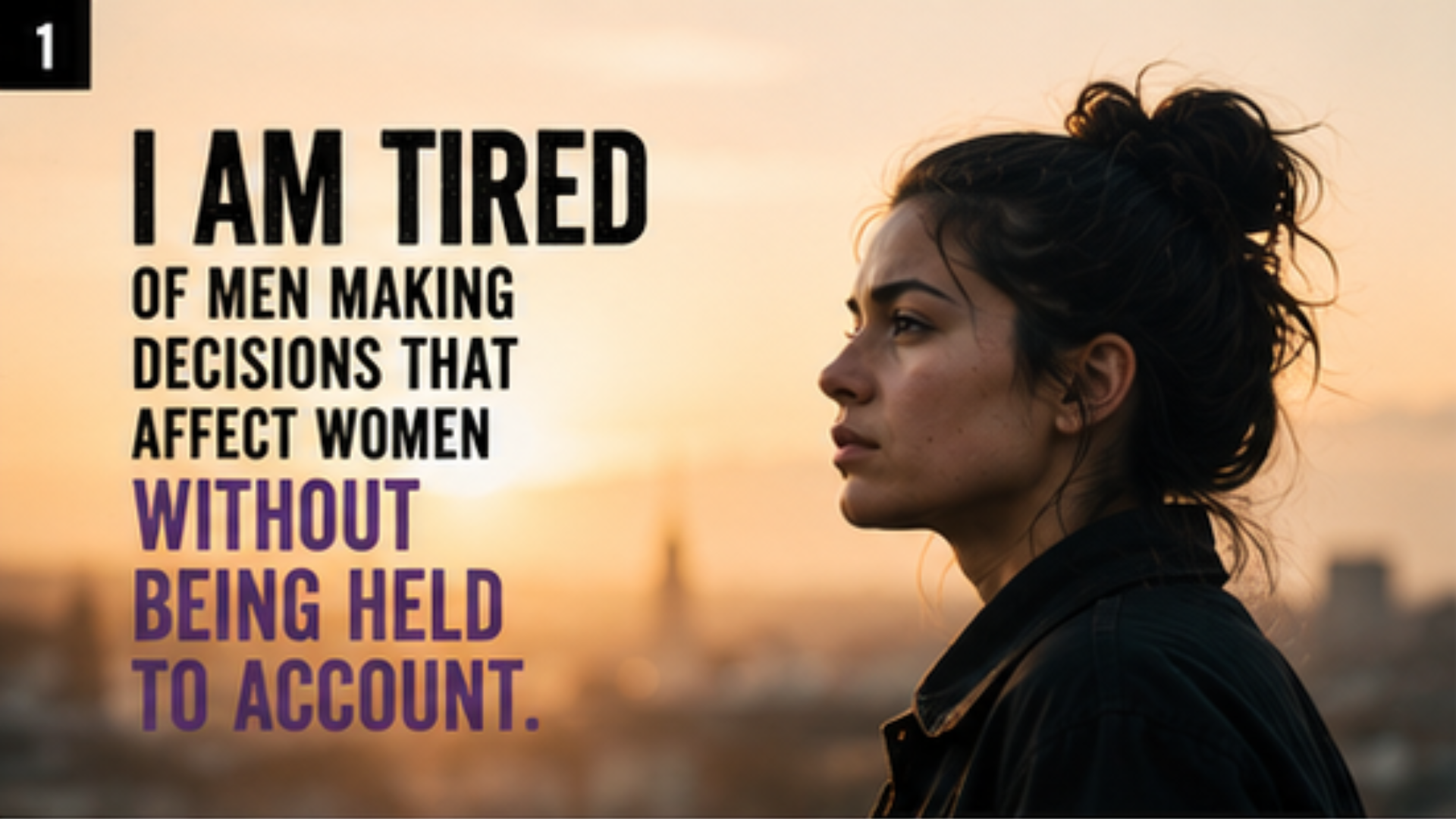
I am tired.
Not in the vague, passing sense.
I am tired in the way women become tired when they realise the same patterns have been repeating for generations.
I am tired of men making decisions that affect women’s bodies, women’s safety, women’s work, women’s choices, women’s rights, women’s boundaries, and women’s futures – while too often avoiding the consequences of those decisions.
I am tired of women being told to be patient.
I am tired of women being told to calm down.
I am tired of women being told to be reasonable, polite, measured, grateful, understanding, compassionate, flexible, accommodating, and endlessly forgiving.
I am tired of women being expected to absorb the impact of decisions they were not meaningfully included in.
And I am tired of systems that still treat women’s lived experience as less valid than men’s opinions.
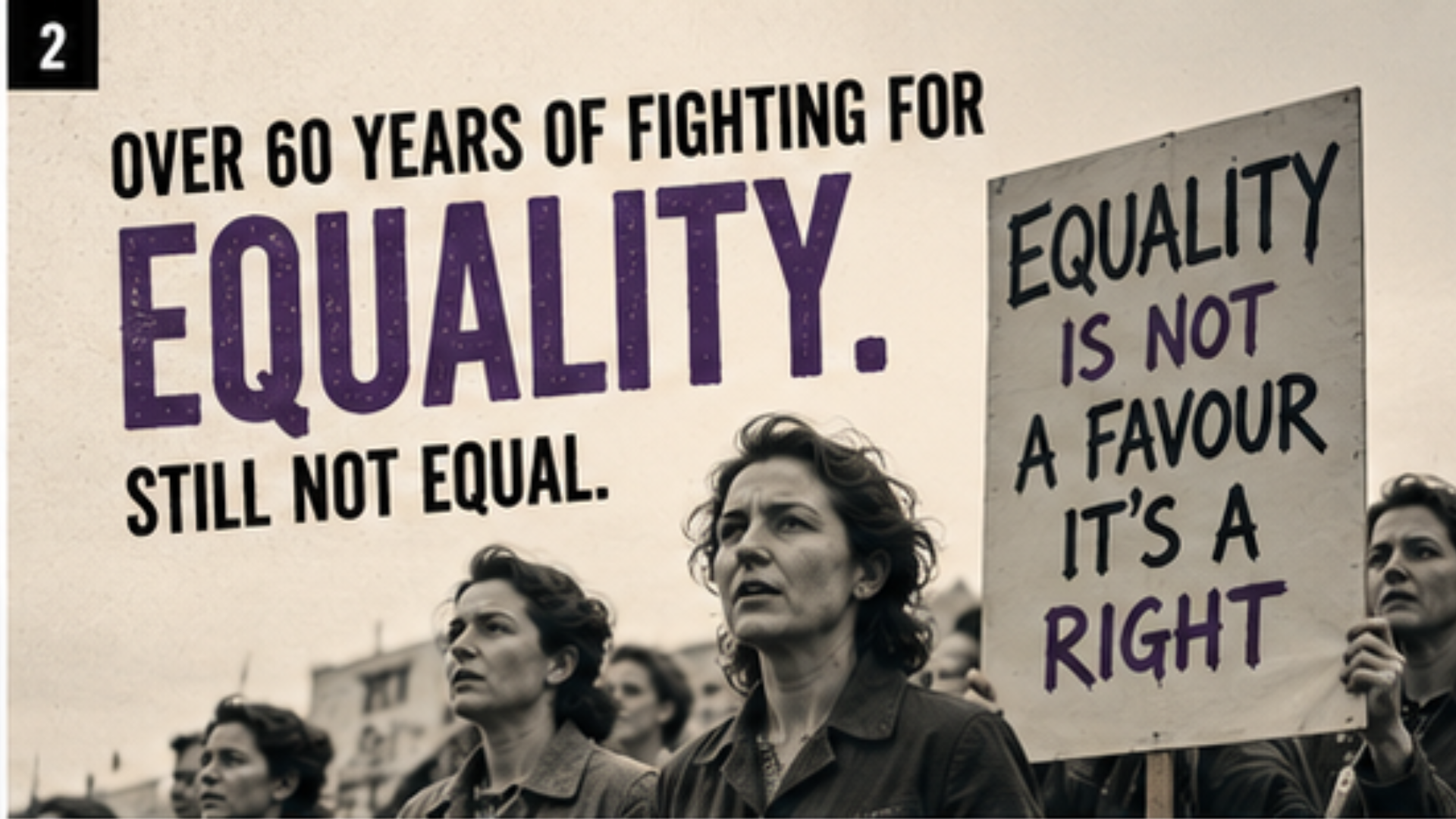
For more than sixty years, the modern feminist movement has pushed for equality. Women have fought for workplace rights, bodily autonomy, fair pay, safety, legal protection, education, representation, and the right to be heard.
And yes, progress has been made.
But progress is not the same as equality.
A woman being allowed into a room does not mean the room has changed.
A woman being given a title does not mean power has been shared.
A woman being told she has choices does not mean those choices are free from fear, penalty, judgement, poverty, violence, or consequence.
We are still living in a world where too many decisions about women are made by people who do not live the cost.
That is the part I cannot ignore.
Women’s bodies have always been treated as public property
History is filled with examples of women’s bodies being controlled, judged, diagnosed, punished, pathologised, and violated.
Women have been labelled hysterical for expressing distress.
Women have been subjected to medical procedures they did not fully consent to.
Women have been denied pain relief because their pain was not believed.
Women have had their reproductive choices restricted, debated, legislated, and morally judged.
Women have been told what to wear, when to have children, whether to have children, how to behave, how to age, how to speak, how to grieve, how to heal, how to survive, and how to recover.
The message has been consistent:
Your body is not fully yours.
Your experience is not fully trusted.
Your voice is not fully authoritative.
And when women object, they are often treated as the problem.
Not the system.
Not the violence.
Not the control.
Not the entitlement.
The woman who names the harm becomes the uncomfortable one.
The woman who asks for safety becomes difficult.
The woman who sets a boundary becomes divisive.
The woman who refuses to stay silent becomes “too much.”
I have had enough of that.
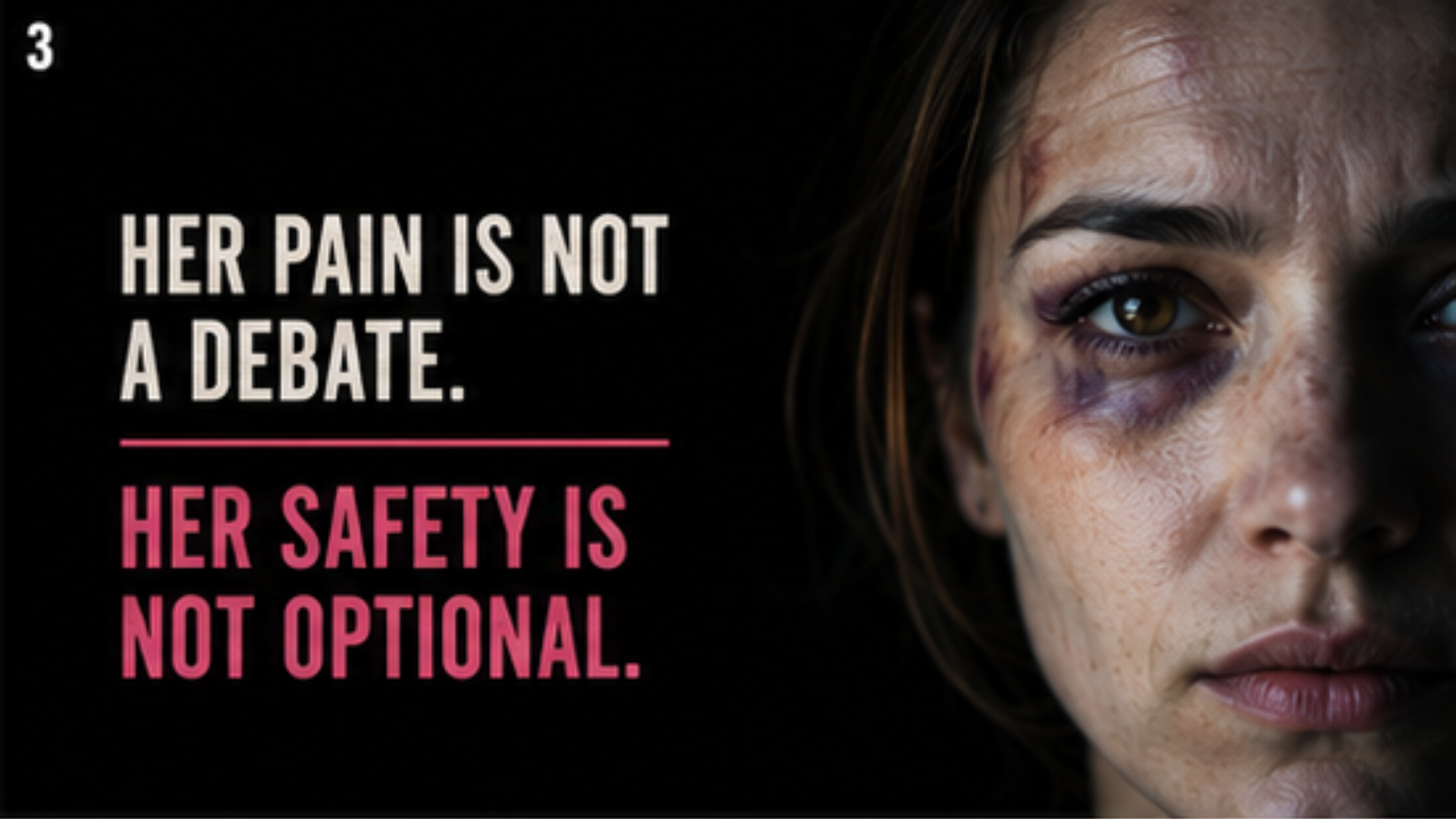
Violence against women is not a private issue
Domestic violence, rape, sexual assault, coercive control, stalking, grooming, emotional abuse, financial abuse, psychological intimidation – these are not isolated private tragedies.
They are social failures.
They are cultural failures.
They are leadership failures.
They are accountability failures.
For too long, women have been asked questions that shift responsibility away from the person who caused harm.
Why didn’t she leave?
What was she wearing?
Why was she there?
Why did she go back?
Why didn’t she report it sooner?
Why didn’t she fight harder?
Why didn’t she speak up?
Why is she angry now?
These questions reveal a deeper problem.
Society is often more comfortable examining a woman’s response to harm than a man’s choice to cause it.
That has to change.
The real questions should be:
Why did he think he had the right?
Who protected him?
Who excused him?
Who ignored the warning signs?
Who benefited from her silence?
Who failed to act?
Who looked away?
Who is still not being held accountable?
Women should not have to perform perfect victimhood to be believed.
They should not have to be calm enough, articulate enough, traumatised enough, respectable enough, wounded enough, or silent enough to deserve safety.
A woman’s humanity should not depend on how palatable her pain is to others.
Women’s work is still undervalued
Women have always worked.
They have worked in homes, in communities, in fields, in factories, in hospitals, in classrooms, in offices, in family businesses, in unpaid roles, in caring roles, in emotional labour, in advocacy, in survival, and in rebuilding lives after harm.
Yet women’s work is still too often undervalued.
When women do the same work as men, they are still too often paid less, promoted less, trusted less, credited less, and scrutinised more.
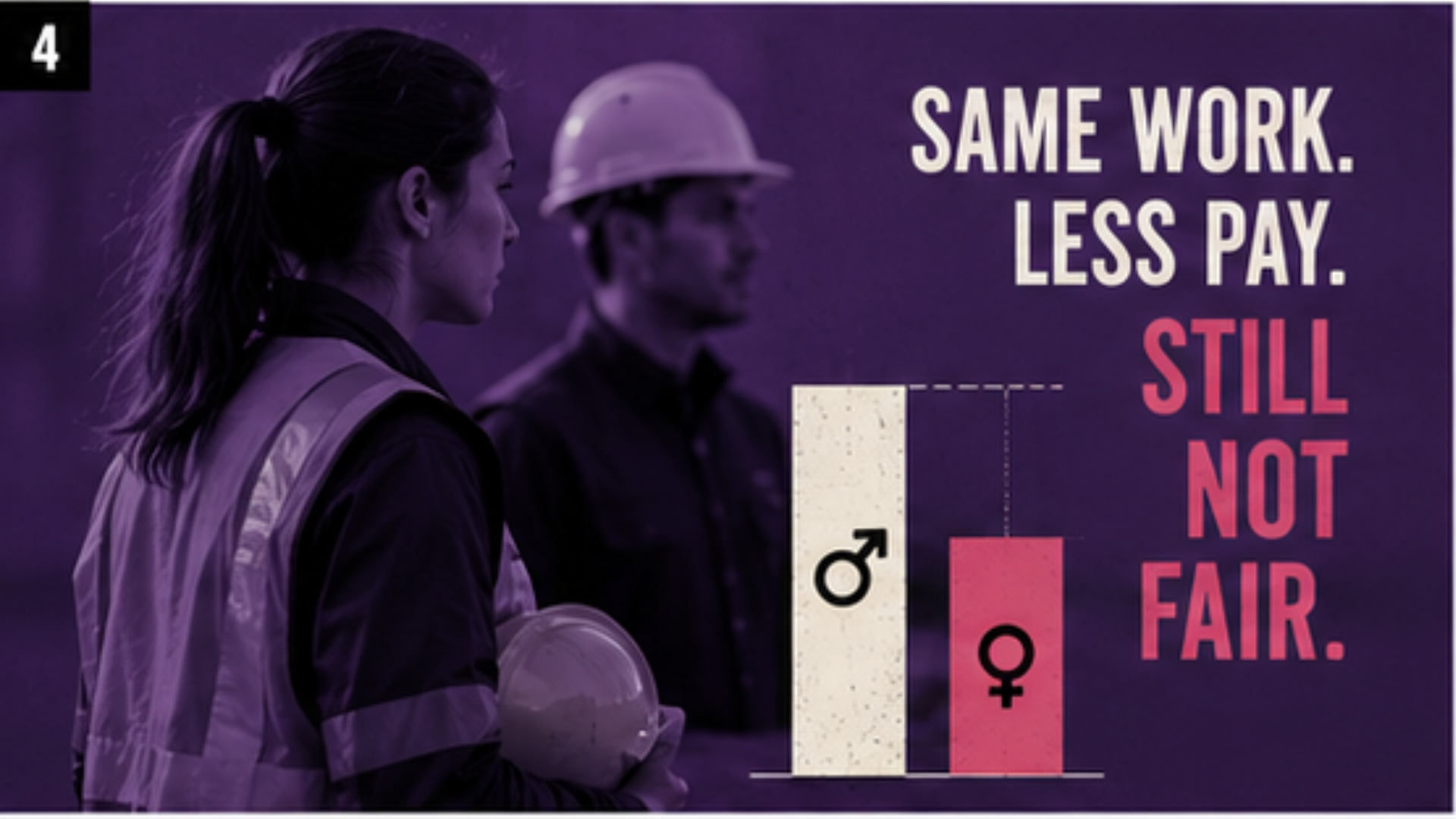
When women enter male-dominated industries, especially trades and manual labour, they often have to prove not only that they can do the job, but that they deserve to be there at all.
When women lead, they are judged for being too soft or too strong.
When women ask for fair pay, they are ambitious.
When women ask for flexibility, they are less committed.
When women have children, their careers are questioned.
When men have children, their stability is often praised.
When women speak with authority, they are bossy.
When men speak with authority, they are confident.
When women care, it is expected.
When men care, it is celebrated.
These double standards are not accidents.
They are part of a system that has normalised women giving more and receiving less.
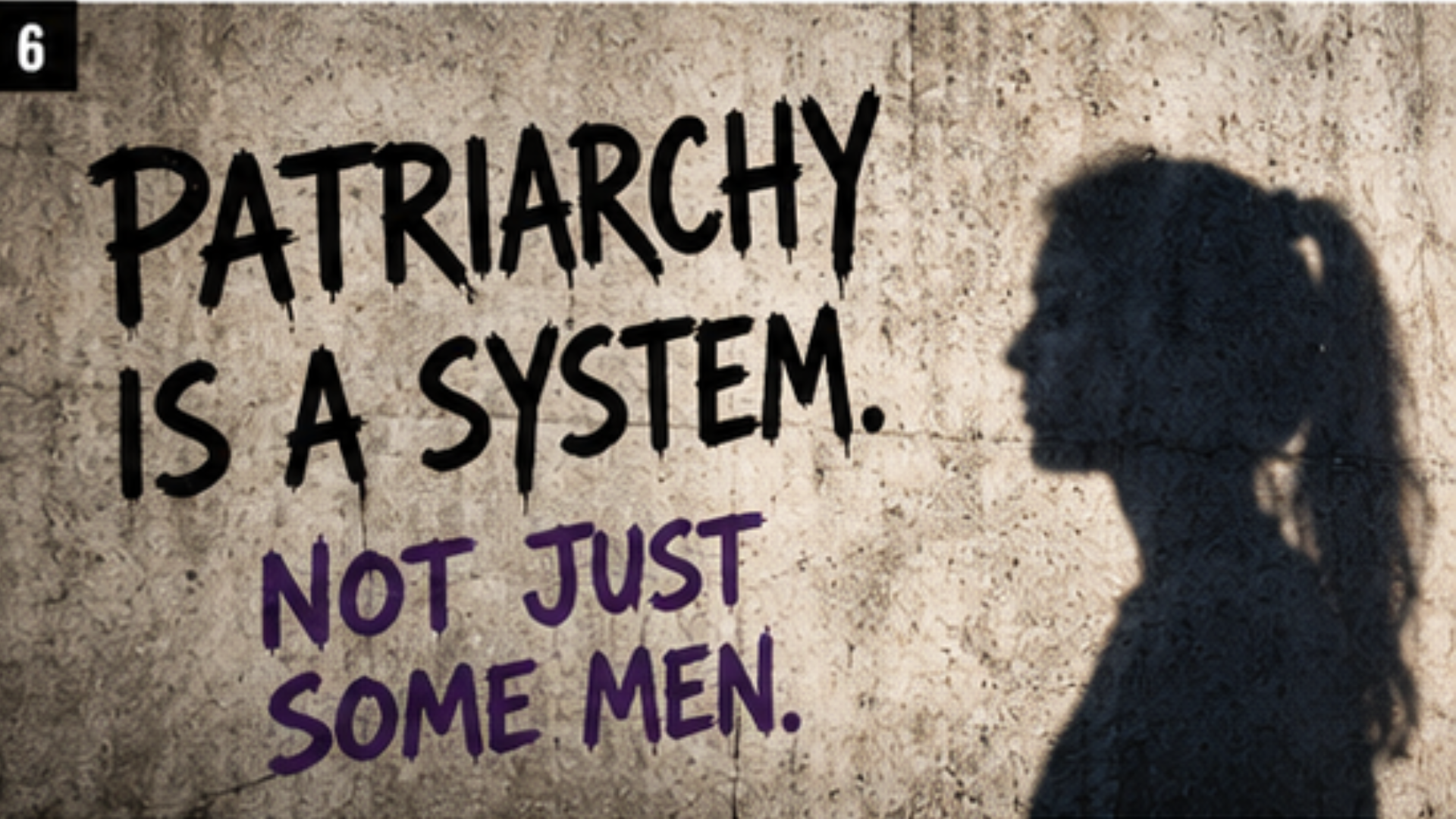
Patriarchy is not just men in power
When I talk about patriarchy, I am not talking about hating men.
I am talking about a system.
A system that has historically centred male authority, male comfort, male credibility, male leadership, male interpretation, and male control.
A system that decides whose voice carries weight.
A system that decides whose anger is acceptable.
A system that decides whose safety is negotiable.
A system that decides whose boundaries matter.
A system that decides who gets protected and who gets doubted.
A system that has trained women to make themselves smaller so others can remain comfortable.
That system harms women deeply.
It can also harm men, because it teaches them to disconnect from vulnerability, accountability, tenderness, and emotional truth.
But let us not pretend the harm is evenly distributed.
Women are still disproportionately expected to carry the emotional, physical, professional, and social costs of decisions made by others.
And many of those decisions are still made in rooms where women are underrepresented, unheard, or treated as symbolic rather than essential.
That is not equality.
That is inclusion without transformation.
Representation is not enough without accountability
We often talk about needing more women at the table.
And we do.
But presence alone is not enough.
Women should not simply be invited into systems that still operate on the same old values.
Women should not be expected to adapt to structures that were never designed with their safety, bodies, caregiving responsibilities, trauma histories, or lived realities in mind.
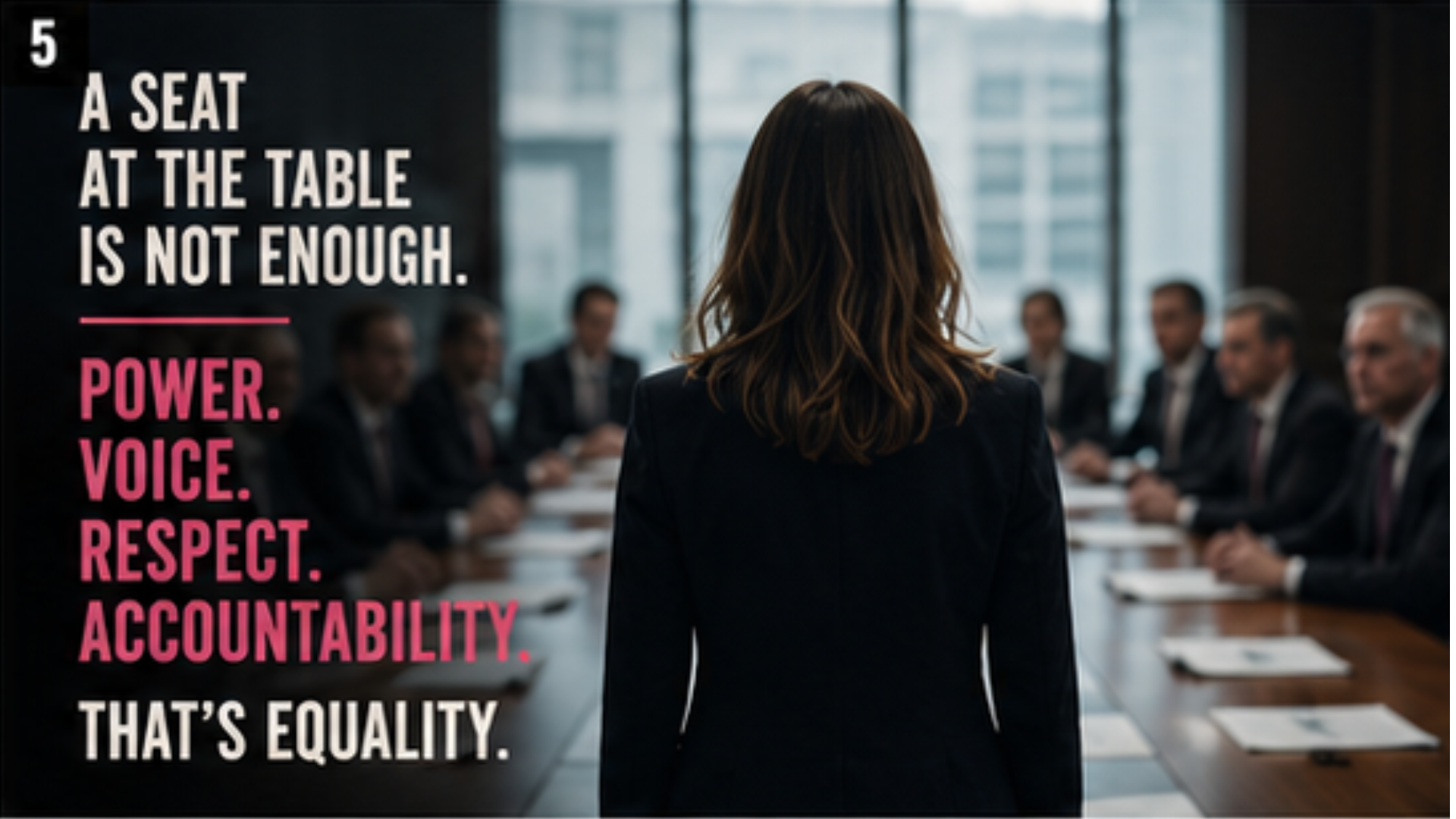
Representation matters.
But accountability matters too.
Who has decision-making power?
Who is listened to?
Who is dismissed?
Who is protected?
Who faces consequences?
Who gets promoted after harm?
Who gets quietly moved sideways?
Who gets silenced with confidentiality agreements?
Who gets believed without evidence?
Who has to provide endless proof?
Who pays the price?
Until those questions are answered honestly, equality will remain partial.
And women know it.
We feel it in workplaces.
We feel it in healthcare.
We feel it in relationships.
We feel it in courtrooms.
We feel it in policy debates.
We feel it in the way our stories are questioned, softened, edited, explained away, or turned into “complex issues” when the truth is often painfully clear.
Difficult conversations cannot come at women’s expense
There are many complex conversations happening now around gender, identity, fairness, safety, inclusion, and rights.
Those conversations matter.
Every human being deserves dignity.
Every person deserves freedom from abuse, humiliation, and violence.
But compassion for one group cannot require the erasure, silencing, or shaming of women who raise legitimate concerns about safety, fairness, privacy, and boundaries.
Women should be able to speak about female-only spaces.
Women should be able to speak about fairness in sport.
Women should be able to speak about the importance of sex-based protections in contexts where biology matters.
Women should be able to speak without being immediately branded hateful, cruel, ignorant, or dangerous.
A mature society should be able to hold more than one truth at once.
Trans people deserve dignity and safety.
Women and girls also deserve dignity and safety.
The answer cannot be to demand that women stop naming their concerns.
Women have been asked to be silent for centuries.
We should be very careful about any movement, policy, institution, or ideology that asks women to surrender their language, boundaries, or hard-won protections in the name of progress.
Progress that requires women’s silence is not progress.
Women are tired of being told to wait
Women have waited.
Women have waited for laws to catch up.
Women have waited for workplaces to change.
Women have waited for police to take violence seriously.
Women have waited for courts to understand coercive control.
Women have waited for medical systems to believe their pain.
Women have waited for equal pay.
Women have waited for leadership opportunities.
Women have waited for safety in homes, streets, schools, workplaces, sporting clubs, churches, communities, and online spaces.
Women have waited while being told that change takes time.
But how much time is enough?
How many generations of women must explain the same harm?
How many reports must be written?
How many inquiries must be held?
How many statistics must be published?
How many stories must be shared?
How many women must be harmed before society stops treating women’s safety as a topic and starts treating it as a responsibility?
I am not interested in performative concern.
I am interested in accountability.
I am interested in systems that change because women told the truth.
I am interested in leadership that does not need women to be harmed before it listens.
I am interested in workplaces where fairness is not a slogan.
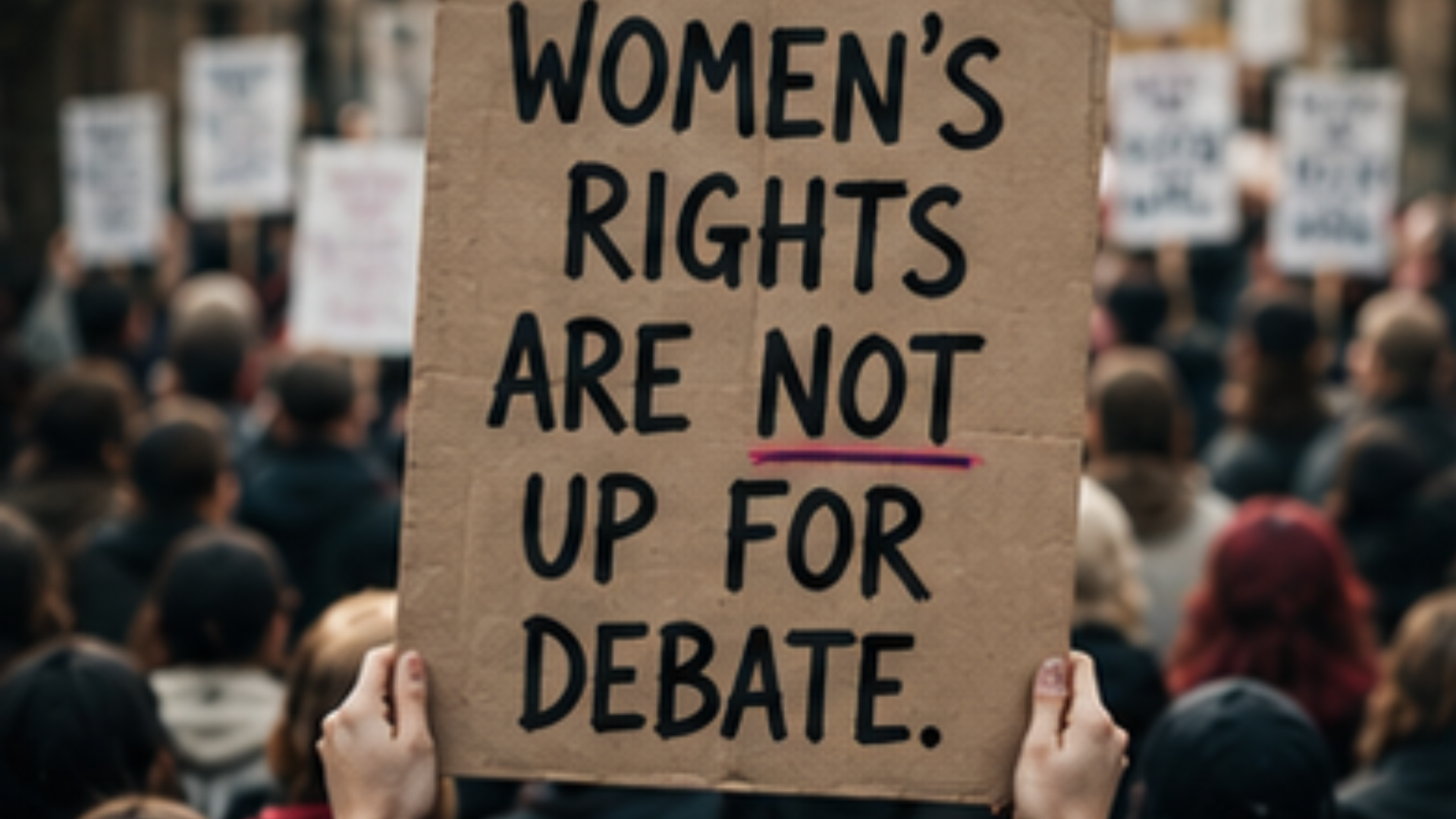
I am interested in communities where women’s boundaries are not up for debate.
I am interested in justice that does not depend on a woman being destroyed before she is believed.
Lived experience is evidence
One of the reasons I care so deeply about storytelling is because lived experience reveals what systems often hide.
Policies can look good on paper and still fail women in practice.
Workplaces can have equality statements and still punish women who speak up.
Organisations can celebrate International Women’s Day and still ignore harassment, pay gaps, discrimination, unsafe leadership, or bullying.
Communities can claim to support women and still protect powerful men.
That is why lived experience matters.
It shows us the gap between what is promised and what is real.
When women tell the truth about what they have lived through, they are not being dramatic.
They are documenting reality.
They are showing us where the system breaks.
They are showing us where language has replaced action.
They are showing us where power still protects itself.
And that is why women’s stories are so often resisted.
Because a woman’s story, told clearly, can expose what institutions would rather keep hidden.
Equality will not come from politeness alone
I value kindness.
I value care.
I value thoughtful conversation.
I value dignity.
But I no longer believe women should have to make injustice sound gentle in order to be heard.
There is a difference between being compassionate and being compliant.
There is a difference between being respectful and being silent.
There is a difference between being fair and being expected to accept harm quietly.
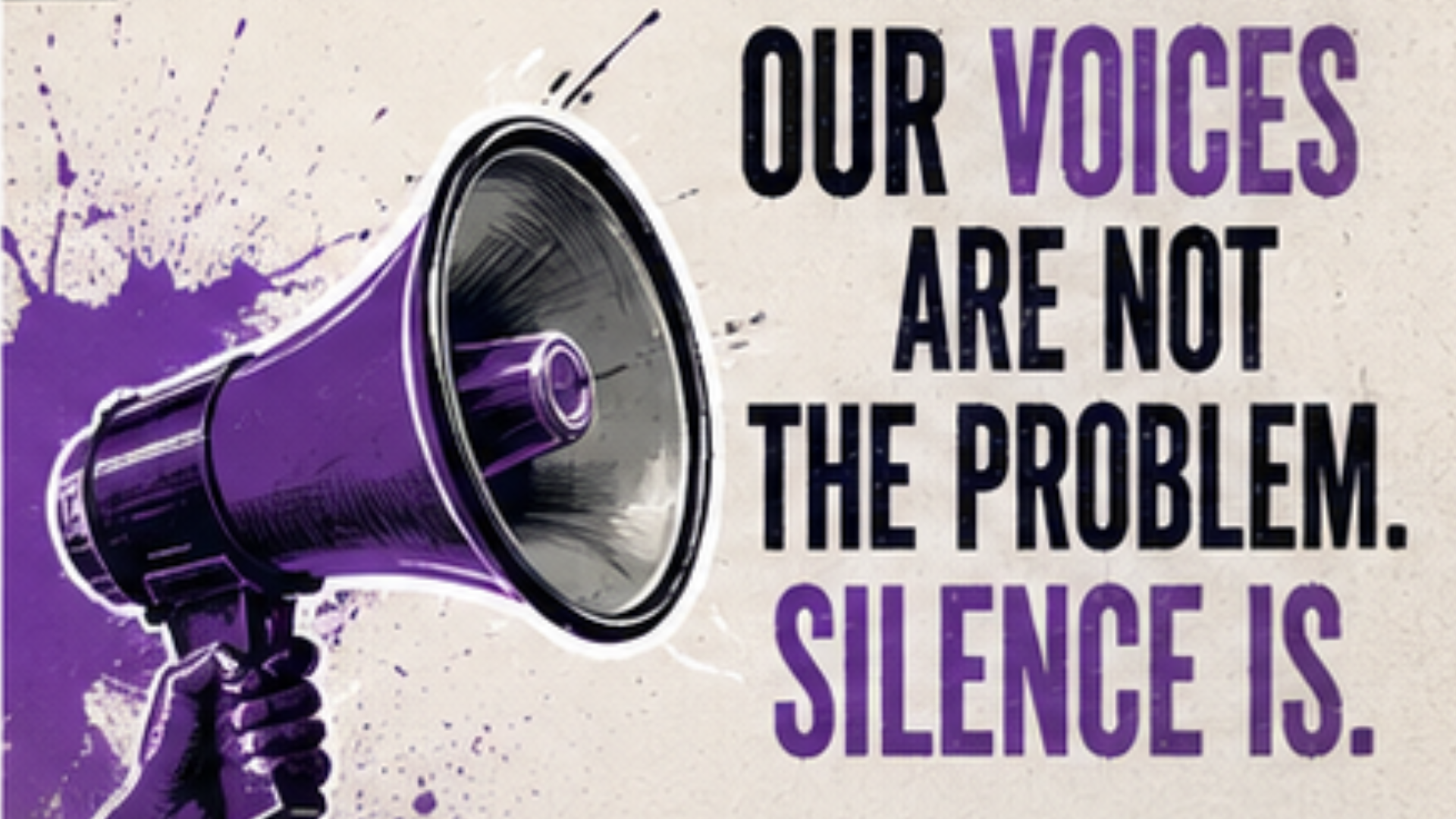
Women’s anger has been demonised because anger is clarifying.
Anger says, “This is not acceptable.”
Anger says, “I can see the pattern.”
Anger says, “I refuse to carry what is not mine.”
Anger says, “You do not get to keep harming people and call their reaction the problem.”
Women’s anger is not the enemy.
Unaccountable power is.
What needs to change?
Men who make decisions that affect women need to be accountable to women.
That means women must be meaningfully included in decision-making, not added as decoration after the real decisions have already been made.
It means lived experience must be treated as knowledge, not merely personal opinion.
It means women’s safety must be designed into policies, workplaces, systems, and communities from the beginning.
It means violence against women must be treated as a leadership issue, not only a personal issue.
It means pay equity must be measured and corrected, not endlessly discussed.
It means women in male-dominated industries must be protected from harassment, exclusion, and retaliation.
It means medical systems must listen to women’s pain and respect women’s consent.
It means institutions must stop prioritising reputation over truth.
It means men who abuse, exploit, silence, endanger, or discriminate must face consequences.
It means women should not have to risk their livelihoods, reputations, relationships, safety, or mental health in order to speak.
And it means we must stop calling women divisive when they name the division that already exists.
I am not asking for permission anymore
For a long time, women have been taught to ask carefully.
To soften.
To explain.
To make the truth easier to receive.
To make pain more comfortable for the listener.
To say, “I might be wrong, but…”
To say, “I do not want to offend anyone, but…”
To say, “I am not angry, but…”
But sometimes we are angry.
And sometimes anger is appropriate.
I am angry that women are still unsafe.
I am angry that women are still underpaid.
I am angry that women are still disbelieved.
I am angry that women are still expected to carry the emotional burden of systems that harm them.
I am angry that men continue making decisions about women’s lives without being held accountable for the outcomes.
And I am angry that when women name this, the conversation so often shifts to whether our tone is acceptable.
My tone is not the issue.
The issue is the harm.
The issue is the pattern.
The issue is the lack of accountability.
The issue is that women are still being asked to accept what should never have been normal.
Where does it end?
Maybe it ends when women stop pretending we are further along than we are.
Maybe it ends when we stop confusing access with equality.
Maybe it ends when women’s lived experience is treated as evidence.
Maybe it ends when institutions fear failing women more than they fear being exposed.
Maybe it ends when men in leadership understand that accountability is not an attack.
Maybe it ends when women’s safety is no longer negotiable.
Maybe it ends when the next generation of girls does not have to inherit the same fight with better branding.
Maybe it ends when women refuse to keep making themselves smaller to protect systems that were never built for them.
I do not have all the answers.
But I know this.
Women are not asking for special treatment.
Women are asking for dignity.
Women are asking for safety.
Women are asking for fairness.
Women are asking for bodily autonomy.
Women are asking for equal pay.
Women are asking to be believed.
Women are asking to be included in decisions that shape their lives.
Women are asking for accountability.
And after everything women have endured, that is not too much to ask.
It is the bare minimum.
So yes, I am tired.
But I am also awake.
And I am not interested in polite silence anymore.
What are women still being asked to accept that should never have been normal?
#GenderEquality #WomensRights #Accountability #Patriarchy #WomensSafety #EqualPay #LivedExperience #DomesticViolenceAwareness #WomenInLeadership #SocialJustice #Feminism #RoseDavidson